Leading Through Change: How Wineries Navigate Uncertainty Through Leadership
Change is not new to the wine industry. Weather patterns shift, markets evolve, and each vintage brings its own uncertainties. What has changed is the intensity and frequency with which these forces converge. Climate volatility, labor constraints, generational transitions, and evolving consumer expectations are no longer episodic challenges—they form the operating context of the industry.
In this environment, the question facing wineries is not whether change will occur, but how it will be led.
Change is experienced locally, not strategically
Strategic decisions about change are often made at the top of the organization. However, change is lived at the operational level. It is experienced in altered schedules, new processes, shifting priorities, and increased pressure on teams already operating near capacity.
For frontline teams, change is rarely abstract. It shows up in how work is reorganized, how expectations shift, and how uncertainty is communicated. When leadership fails to bridge the gap between strategic intent and lived experience, resistance emerges—not as opposition, but as fatigue, disengagement, or quiet compliance.
Effective leadership during change begins with recognizing this reality.
The role of supervisors during transition
Supervisors sit at the center of change dynamics in wineries. They are responsible for translating evolving priorities into daily action while maintaining productivity, safety, and team cohesion. At the same time, they absorb anxiety from both directions—above and below.
When supervisors are unsupported, change becomes destabilizing. Messages become inconsistent. Pressure intensifies. Teams lose clarity about what matters most. Over time, this erodes trust and undermines performance.
When supervisors are equipped as leaders, however, they become anchors during transition. They provide continuity, contextualize decisions, and help teams make sense of uncertainty without minimizing its impact.
Multicultural teams and change resilience
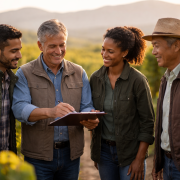
The wine industry relies on multicultural teams whose members often bring deep adaptability forged through lived experience. These teams can be a source of resilience during change—if leadership recognizes and engages that strength.
Change initiatives fail when they assume uniform reactions and communication styles. They succeed when leaders create space for dialogue, acknowledge different concerns, and establish shared clarity without imposing sameness.
Leadership during change is less about control and more about coherence: ensuring that people understand not only what is changing, but why, how, and what remains stable.
Change without trust accelerates burnout
Poorly led change compounds existing pressures. When communication is rushed, inconsistent, or dismissive, uncertainty increases rather than decreases. Teams respond by disengaging, overextending themselves, or leaving altogether.
Burnout during periods of change is often interpreted as resistance or lack of resilience. In reality, it is frequently a signal of leadership strain. People can adapt to demanding conditions when they trust the leadership guiding them through it.
Trust is not built through reassurance alone, but through presence, transparency, and follow-through—especially when outcomes are uncertain.
Leading change as an ongoing capability
In today’s wine industry, change leadership cannot be treated as a one-time skill or project-based effort. It must become a core leadership capability embedded at multiple levels of the organization.
This means developing leaders who can:
-
communicate with clarity under pressure,
-
hold space for uncertainty without paralysis,
-
align teams without suppressing difference,
-
and sustain performance while navigating transition.
Organizations that invest in these capabilities move through change more deliberately—and recover more quickly when plans are tested.
The Vine Leaders perspective
At Vine Leaders, we work with wineries that recognize change as a permanent condition rather than an exception. We focus on strengthening leadership where change is felt most directly—at the supervisory and frontline leadership levels.
Our approach treats change leadership not as a communication exercise, but as a relational discipline grounded in trust, clarity, and shared accountability.
In an industry defined by uncertainty and tradition alike, the wineries that thrive will not be those that avoid change, but those that learn to lead through it—consistently, humanely, and with purpose.